
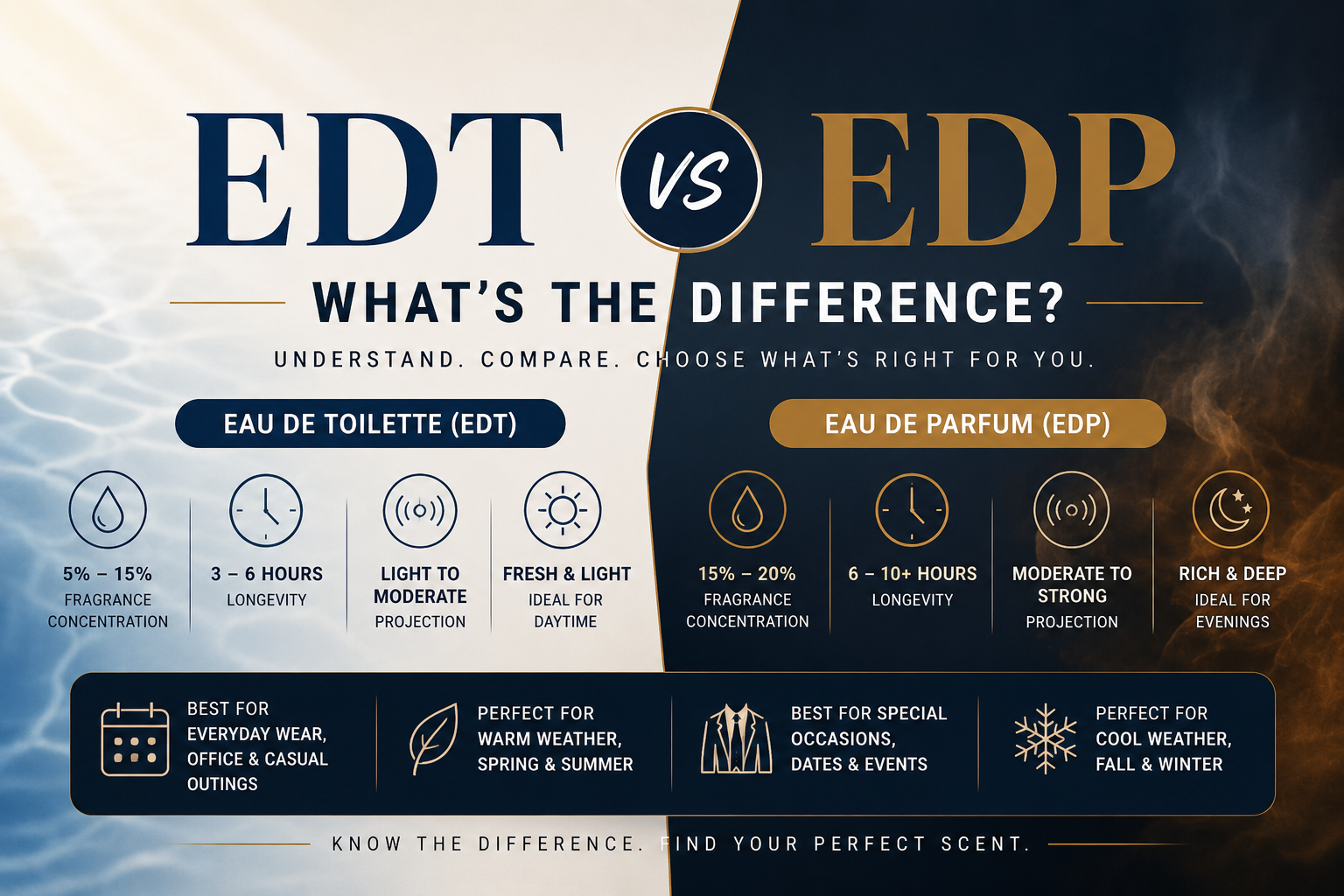
Learn the difference between EDT and EDP. Compare perfume concentration, longevity, projection, and discover which fragrance type is best for you.
If you’ve ever shopped for a perfume, you’ve probably noticed labels like EDT (Eau de Toilette) and EDP (Eau de Parfum). While they may look similar, these fragrance types differ in concentration, longevity, projection, and the way they perform throughout the day.
One of the most common questions fragrance buyers ask is:
“Should I buy EDT or EDP?”
The answer depends on your lifestyle, budget, climate, and how long you want your fragrance to last.
In this complete guide, you’ll learn the real difference between EDT and EDP, how perfume concentrations work, and which option is best for daily wear, office use, special occasions, and different seasons.
Whether you’re buying your first fragrance or adding to your collection, understanding these perfume types will help you make a smarter purchase.
Eau de Toilette (EDT) is one of the most popular perfume concentrations in the fragrance industry.
It contains a lower percentage of fragrance oil, making it lighter, fresher, and perfect for everyday wear.
Most EDT fragrances contain approximately:
The remaining formula consists of alcohol and purified water, allowing the scent to feel clean, refreshing, and easy to wear.
Because of its lighter concentration, EDT is especially popular in warm climates and during the summer months.
People often choose EDT because it offers:
✔ Fresh feeling
✔ Comfortable daily wear
✔ Office-friendly scent
✔ Affordable price
✔ Ideal for beginners
EDT fragrances are designed to provide freshness without becoming overwhelming.
Eau de Toilette is an excellent choice for:
Its lighter projection makes it suitable for environments where strong fragrances may not be appropriate.
Eau de Parfum (EDP) contains a higher concentration of fragrance oils than EDT.
Typical concentration:
This higher concentration allows the fragrance to develop with greater richness, depth, and longevity.
EDP fragrances usually evolve more slowly, allowing wearers to enjoy every stage of the perfume—from the opening top notes to the deep, long-lasting base notes.
Many fragrance enthusiasts prefer EDP because it provides:
✔ Longer-lasting performance
✔ Stronger scent trail
✔ Rich fragrance profile
✔ Better depth
✔ More luxurious experience
Because of its concentration, EDP generally requires fewer sprays than EDT.
Eau de Parfum is ideal for:
Its richer composition makes it more noticeable and memorable.
Many people believe that a perfume smells better simply because it is expensive.
In reality, one of the biggest factors influencing a fragrance’s performance is its concentration.
The higher the perfume oil concentration:
However, this does not automatically mean that EDP is always better than EDT.
For example, a fresh citrus fragrance in EDT may perform perfectly during a hot summer day, while the same scent in a stronger concentration might feel too heavy in the same weather.
The best choice depends on how and where you plan to wear your fragrance.
| Feature | EDT | EDP |
|---|---|---|
| Fragrance Oil | 5–15% | 15–20% |
| Longevity | 3–6 Hours | 6–10+ Hours |
| Projection | Light to Moderate | Moderate to Strong |
| Best Season | Spring & Summer | Autumn & Winter |
| Best For | Daily Wear | Special Occasions |
| Price | Usually More Affordable | Usually More Expensive |
This comparison gives a quick overview, but choosing the right option also depends on your personal preferences, skin chemistry, and lifestyle.
One of the biggest differences between EDT and EDP is how long they stay noticeable on your skin.
Because Eau de Parfum (EDP) contains a higher concentration of fragrance oils, it generally lasts longer than Eau de Toilette (EDT).
Keep in mind that longevity also depends on:
For example, woody and amber fragrances naturally last longer than citrus-based scents, regardless of concentration.
Many people confuse projection with sillage, but they describe different aspects of a perfume’s performance.
Projection refers to how far a fragrance radiates from your body during the first few hours after application.
A perfume with strong projection is easily noticed by people nearby.
Generally:
If you prefer a fragrance that feels subtle and close to the skin, EDT may be a better choice. If you enjoy making a stronger impression, EDP is often the better option.
Sillage (pronounced see-yazh) is the scented trail left behind as you move.
A fragrance with good sillage creates a memorable impression without needing to be overpowering.
In most cases:
Hot weather changes the way fragrances perform.
High temperatures increase evaporation, making perfumes project more strongly.
This is why lighter fragrances are usually more comfortable during summer.
✔ Feels lighter on the skin
✔ Refreshing citrus opening
✔ Less likely to become overwhelming
✔ Comfortable for daily wear
Fresh aquatic and marine fragrances in EDT concentration are especially popular during warm weather.
These fragrance families provide a clean and refreshing feeling throughout the day.
Cold weather reduces fragrance projection, allowing richer perfumes to perform beautifully.
This is where EDP often shines.
✔ Richer fragrance profile
✔ Longer-lasting warmth
✔ Better projection in cooler temperatures
✔ Ideal for evening wear
Popular winter fragrance notes include:
These ingredients create a warm, luxurious fragrance experience.
Choosing the right office fragrance is important because strong perfumes can become distracting in shared spaces.
For professional environments, subtlety is key.
EDT is often preferred because it offers:
Fresh citrus and marine fragrances are excellent office companions.
However, if you wear an EDP, apply fewer sprays to keep the scent balanced.
Many buyers assume EDT is always the better deal because it usually costs less.
However, value depends on how much fragrance you use.
If you wear perfume for long working hours or special occasions, EDP may provide better long-term value despite the higher purchase price.
Imagine two people attending different events.
Going to university during summer.
The weather is hot.
Classes last four hours.
A fresh marine EDT is likely the better choice because it feels clean, refreshing, and comfortable.
Attending an evening wedding reception.
The event lasts six hours.
A rich woody or amber EDP provides better longevity and leaves a lasting impression throughout the evening.
This example shows that neither EDT nor EDP is universally better—it depends on the occasion.
Many fragrance buyers make simple mistakes that lead to disappointment.
Avoid these common errors:
❌ Assuming EDP is always better than EDT
❌ Buying perfume without testing it on your skin
❌ Ignoring Pakistan’s hot climate when selecting fragrances
❌ Applying too many sprays of an EDP
❌ Choosing only based on price
❌ Expecting citrus fragrances to last as long as woody fragrances
❌ Forgetting that body chemistry affects performance
The best fragrance is the one that suits your lifestyle, preferences, and environment.
Before purchasing your next perfume, keep these professional tips in mind:
✔ Test the fragrance on your skin, not just a paper strip.
✔ Give the perfume at least 30–60 minutes to develop before deciding.
✔ Think about where you’ll wear it most often.
✔ For daily wear, lighter fragrances are often more practical.
✔ For evening events or long occasions, choose richer, longer-lasting fragrances.
✔ Quality always matters more than simply choosing the highest concentration.
One of the biggest myths in the fragrance world is that Eau de Parfum (EDP) is always better than Eau de Toilette (EDT). The truth is that neither is universally better—the right choice depends on your lifestyle, climate, budget, and the occasions you wear fragrance.
If you spend most of your time in an office, university, or outdoors during hot weather, a fresh EDT may actually be the smarter option because it feels lighter and more comfortable.
On the other hand, if you want a fragrance that lasts through long evenings, weddings, or formal events, an EDP is usually the better choice due to its richer concentration and longer performance.
The key is to choose the concentration that matches how you wear perfume, not just the one with the higher fragrance oil percentage.
Still unsure which one is right for you? Use this simple guide.
✔ Prefer fresh and light fragrances
✔ Live in a warm climate
✔ Need a daily office perfume
✔ Enjoy citrus or aquatic scents
✔ Want an affordable everyday fragrance
✔ Don’t mind reapplying during the day
✔ Want a long-lasting perfume
✔ Prefer richer, more intense scents
✔ Attend evening events frequently
✔ Like woody, amber, or spicy fragrances
✔ Want fewer sprays with longer wear
✔ Need a fragrance for special occasions
If you’re buying your first perfume, start with your lifestyle instead of focusing only on concentration.
As your collection grows, you’ll naturally find situations where both EDT and EDP have their place.
In most cases, yes. EDP contains a higher percentage of fragrance oils, so it generally lasts longer. However, the ingredients, formulation, and your skin chemistry also affect performance.
EDT has a lower fragrance oil concentration, making it lighter and fresher. That doesn’t mean it’s lower quality—it simply serves a different purpose.
Because Pakistan experiences long, warm summers, fresh EDTs and light EDPs are excellent choices for daytime wear. During cooler months and evenings, richer EDPs can provide a warmer, longer-lasting experience.
If you want better longevity and stronger performance, many people find EDP worth the higher price. If you mainly need a fragrance for everyday daytime use, EDT can offer excellent value.
Absolutely. Many fragrance enthusiasts keep both:
This gives you flexibility throughout the year.
When comparing EDT vs EDP, remember that the difference isn’t about one being “good” and the other being “bad.” They are designed for different situations.
If freshness, comfort, and everyday wear matter most, Eau de Toilette is an excellent option.
If longevity, richness, and stronger projection are your priorities, Eau de Parfum is likely the better choice.
The best fragrance is the one that fits your personality, lifestyle, and environment—not simply the one with the highest concentration.
Understanding the difference between EDT and EDP helps you make a smarter fragrance purchase and avoid common buying mistakes.
Instead of choosing a perfume based only on price or popularity, consider how you’ll use it. Think about your daily routine, the climate where you live, and the occasions you wear fragrance.
Whether you prefer the refreshing feel of an Eau de Toilette or the luxurious depth of an Eau de Parfum, selecting the right concentration ensures you get the best performance and the most enjoyable fragrance experience.
A well-chosen perfume isn’t just something you wear—it’s part of your personal style and the impression you leave behind.
Copyright © 2026 Embroze. All Rights Reserved.